If you are shopping for an infrared PEMF mat, the options can start looking very similar very quickly.
PEMF. Far infrared. Crystals. Negative ions. Red light. Heat. Frequencies. Gauss. Recovery. Grounding.
The problem is that these terms do not all describe the same technology—and two mats that look almost identical can be built very differently underneath.
So before asking which infrared PEMF mat is “best,” it helps to understand what you are actually paying for.
The short version
A good infrared PEMF mat should give you:
-
True full-body PEMF coverage, not a few isolated coils
-
Adjustable PEMF programs or frequencies
-
Even, controllable infrared heat
-
Clear specifications rather than vague wellness claims
-
A comfortable full-body surface
-
Independent control of the different therapies
-
Materials you are comfortable lying on regularly
-
A setup simple enough that you will actually use it
And if a mat also includes red and near-infrared light, understand that this is a separate technology from infrared heat—and a meaningful addition rather than another name for the same feature.
That distinction is where a lot of shopping confusion starts.
First: What is an infrared PEMF mat?
At its simplest, an infrared PEMF mat combines two technologies.
PEMF
PEMF stands for pulsed electromagnetic field therapy.
Coils embedded inside the mat generate controlled electromagnetic pulses while you lie on it.
Depending on the system, you may be able to select different programs, frequencies, or intensities.
Infrared heat
Infrared heating elements create warmth across the mat.
This is primarily a heat-based modality. The warmth can make the experience relaxing and may help muscles feel looser and more comfortable.
Those two technologies can work in the same session, but they are not doing the same thing.
And then there is a third technology that some mats include.
Infrared heat is not the same as red light therapy
This is probably the single most useful distinction to understand before buying.
A mat can advertise “infrared” and contain no therapeutic red-light LEDs at all.
Infrared heat warms tissue.
Red and near-infrared photobiomodulation use specific wavelengths of light delivered by LEDs or lasers.
Red light commonly sits around the 600 nm range, while near-infrared photobiomodulation commonly uses wavelengths in the 800 nm range.
They are different modalities.
So when comparing mats, ask:
Does this mat contain infrared heating elements only—or does it also contain actual red and near-infrared LEDs?
If cellular light therapy is one of the reasons you are buying it, that difference matters.
What matters most when choosing a PEMF mat?
There is no single specification that automatically makes one mat the best.
You want to look at the whole system.
1. PEMF coil coverage
This is one of the easiest specifications to overlook.
The coils are what generate the pulsed electromagnetic field.
Some mats use only a handful of coils positioned at different points along the body. That means the field is concentrated around those zones rather than being distributed as evenly from head to toe.
If you are buying a full-body PEMF mat, look at how many coils are actually inside it and how they are distributed.
More isn’t automatically better in every engineering application, but coil placement and coverage matter considerably when the entire selling point is full-body exposure.
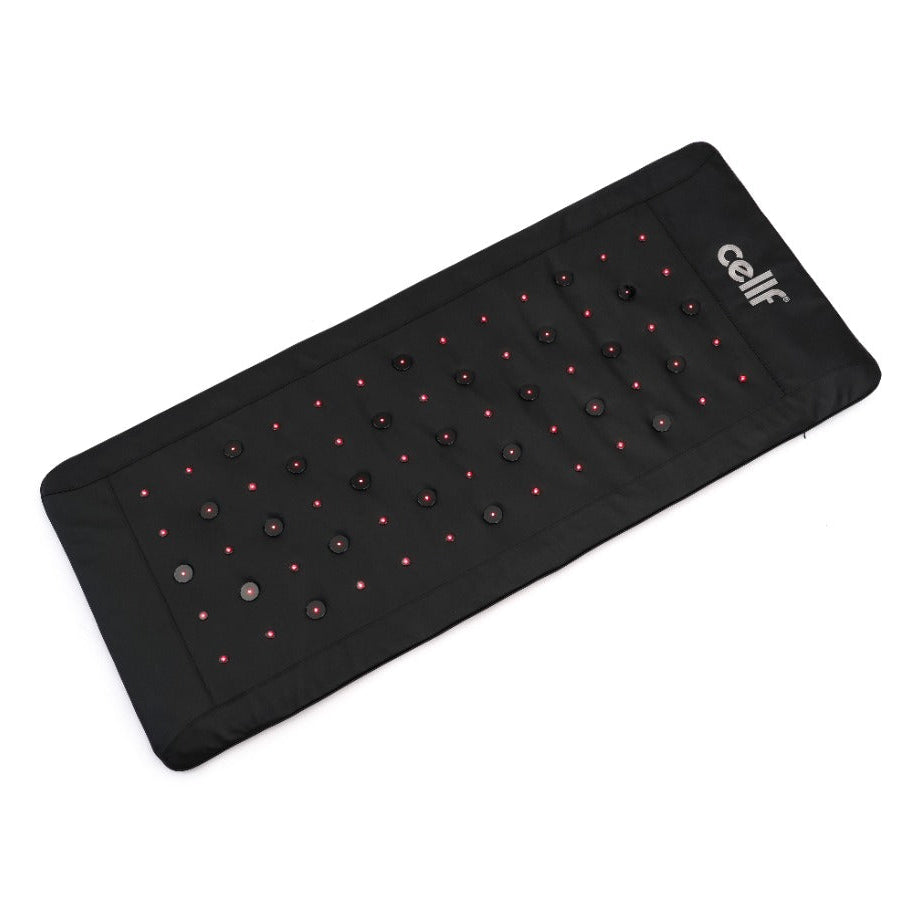
The CELLF Multi-Therapy Mat uses 25 PEMF coils distributed across the full mat, rather than relying on a small number of isolated treatment zones. (Cellf.com)
2. PEMF controls
Not everyone wants exactly the same session every day.
A useful mat should make it simple to choose between preset programs and, ideally, more personalized control when you want it.
Some people use PEMF primarily as part of an evening wind-down routine.
Others use it around recovery, meditation, morning routines, or focused wellness sessions.
You do not necessarily need dozens of confusing settings.
You do want enough control that the mat can adapt to how you actually plan to use it.
3. Heat range and control
Heat is often what you notice first when lying on an infrared mat.
Look for:
-
Adjustable temperature
-
Even heat across the surface
-
An automatic timer
-
Controls that are easy to understand
-
A temperature range that allows both gentle warmth and hotter sessions
The CELLF mat has adjustable infrared heat from 86–158°F / 30–70°C, so heat can be used lightly or more intensely depending on the session. (Cellf.com)
4. Red and near-infrared light
This is where some multi-therapy mats become much more interesting.
If red-light therapy is built into the mat, check the actual wavelengths.
CELLF uses:
660 nm red light
850 nm near-infrared light
These are two commonly used wavelength ranges in photobiomodulation.
The current CELLF system delivers the light alongside PEMF and infrared heat, but the modalities can also be controlled independently. (Cellf.com)
That means you are not required to use every feature every time you lie down.
5. Can the therapies operate independently?
This matters more than it sounds.
Maybe you want warmth before bed but no light.
Maybe you want PEMF without turning the heat up.
Maybe you want red and near-infrared light during a recovery session.
A well-designed multi-therapy mat should allow you to use the technologies individually as well as together.
Otherwise, having multiple modalities becomes much less useful.
6. Size and comfort
If the mat is supposed to be full-body, it should actually fit your body.
Also consider what happens after the first week of excitement wears off.
Is it comfortable enough to lie on for 20 or 30 minutes?
Can you put it beside your bed?
Will it fit underneath a sofa or bed when folded?
Is the material easy to clean?
The CELLF mat measures approximately 72 × 24 inches / 183 × 61 cm, weighs around 16 pounds, and folds for storage. It is currently available in neoprene and wipe-clean vegan leather versions. (Cellf.com)
That usability piece matters because the best recovery device is usually the one you actually keep using.
7. Materials and everyday exposure
You are going to be lying directly against the mat, potentially several times a week.
So materials matter.
Look beyond the therapies themselves and ask what the mat is made from, whether the manufacturer provides information about adhesives and electronics, and whether it has been designed for repeated home use.
CELLF specifies low-VOC materials, solvent-free adhesives, and low-EMF electronics in the current Multi-Therapy Mat. (Cellf.com)
So why combine PEMF, infrared heat, and red light?
Because they are three separate inputs.
PEMF delivers pulsed electromagnetic fields.
Infrared heat delivers warmth.
Red and near-infrared light deliver specific wavelengths used in photobiomodulation.
You do not need to pretend they all do the same thing to see the appeal of combining them.
Instead of building a recovery corner with a PEMF system, heating mat, and separate red-light panel, a multi-therapy mat can put several technologies into one session.
That is really the value proposition.
Less equipment.
Less setup.
One place to lie down.
Why the CELLF Multi-Therapy Mat is different
When we developed the CELLF Multi-Therapy Mat, the goal was not to make another heated mat with PEMF added to the feature list.
It was to build a true full-body recovery system.
The current configuration combines:
25 PEMF coils for distributed full-body coverage
660 nm red light
850 nm near-infrared light
Adjustable infrared heat
Independent modality controls
Preset and manual PEMF options
Foldable full-body design
All three primary modalities—PEMF, heat, and light—can be used independently or layered together. (Cellf.com)
That makes it less about having the longest feature list and more about being able to create the kind of session you actually want.
For an evening reset
PEMF + gentle heat.
For recovery
PEMF + red/NIR light + warmth.
When you only want light
Use the red and near-infrared LEDs independently.
When you simply want to lie down and decompress
Choose a preset program, set the temperature, and stop thinking about it.
That simplicity is ultimately what makes a wellness tool become part of a routine instead of another expensive device you stop using.
Do you need crystals in a PEMF mat?
Not necessarily.
A lot of infrared mats are heavily marketed around amethyst, tourmaline, jade, or other stones.
Those materials can retain and distribute heat, and some people enjoy the weight and feel of a gemstone mat.
But they should not distract you from the engineering that actually determines the PEMF experience.
If PEMF is the reason you are shopping, I would prioritize:
Coil architecture → controls → field specifications → comfort → heat → additional modalities
before choosing a mat because it contains a particular crystal.
Who is a multi-therapy PEMF mat best for?
A mat like this makes the most sense for someone who wants one recovery system they can use regularly rather than collecting several separate devices.
That might include someone who:
-
Trains regularly
-
Deals with everyday muscle tension or stiffness
-
Wants a wind-down ritual before bed
-
Spends long hours sitting or traveling
-
Already uses red light or PEMF
-
Wants full-body rather than targeted treatment
-
Likes recovery technology but does not want a room full of equipment
It is also useful for households where several people may use the same recovery setup.
Who probably doesn’t need one?
Not everyone needs a multi-therapy mat.
If you only want heat, buy a good infrared heating mat.
If you only want red light therapy, a dedicated mat, panel, or wearable may make more sense.
If you need to treat one knee or shoulder, a targeted wearable may be more practical.
The value of a multi-therapy PEMF mat comes from actually wanting multiple modalities in one full-body system.
Paying for features you will never use does not make something premium. It makes it expensive.
PEMF mat vs. red light therapy mat
This is another common buying decision.
A dedicated red light therapy mat is built primarily around photobiomodulation.
A PEMF mat is built primarily around electromagnetic field exposure.
A multi-therapy mat combines them.
If your main priority is red light, you may not need PEMF.
If your main priority is building one full-body recovery routine that combines light, PEMF, and heat, then an integrated system makes much more sense.
What should you spend on an infrared PEMF mat?
Infrared PEMF mats now range from several hundred dollars to several thousand.
Price alone tells you very little.
Before comparing numbers, compare what is actually inside.
Ask:
-
How many PEMF coils are there?
-
Where are they positioned?
-
What frequency controls are available?
-
What is the heat range?
-
Are red/NIR LEDs actually included?
-
What wavelengths?
-
Can the modalities be controlled separately?
-
What materials are used?
-
Is it full-body?
-
Can it be folded and stored?
-
Is the company transparent about specifications?
A cheaper mat may be excellent if it does the one thing you want.
A more expensive mat should justify its price through engineering, build quality, control, coverage, or additional technology—not simply prettier branding.
The bottom line
The best infrared PEMF mat is not necessarily the one with the most buzzwords.
Look underneath the cover.
PEMF coil coverage matters.
Heat control matters.
Materials matter.
Red and near-infrared LEDs are different from infrared heating elements.
And if you are paying for multiple therapies, you should be able to control them independently and use them in a way that actually fits your life.
For someone looking specifically for PEMF + infrared heat + red and near-infrared light in one full-body system, the CELLF Multi-Therapy Mat was built around exactly that combination.
Not more equipment.
A better recovery routine.
Frequently Asked Questions
What is the best infrared PEMF mat?
There is no single best mat for everyone. Look for strong PEMF coverage, adjustable heat, transparent specifications, comfortable materials, easy controls, and the modalities you will actually use. If you want red-light therapy as well, confirm that the mat contains actual red/NIR LEDs rather than infrared heat alone.
What should I look for in a PEMF mat?
Start with PEMF coil number and distribution, available frequencies or programs, field specifications, heat control, size, materials, timer settings, and usability. Additional therapies such as red and near-infrared light can add value if you want them.
Are infrared and red light therapy the same thing?
No. Infrared heating elements warm the body. Red and near-infrared photobiomodulation use specific light wavelengths delivered by LEDs or lasers. A device may contain one or both.
How many coils should a PEMF mat have?
There is no universally required number. What matters is how the coils are arranged and the coverage they create. If a product is marketed for full-body PEMF, look for enough evenly distributed coils to avoid relying on only a few isolated treatment zones.
Can you use PEMF and red light together?
Some multi-therapy systems allow them to operate simultaneously. They are separate modalities and can also be used independently when the device is designed to allow that.
Do infrared PEMF mats get hot?
Most include adjustable infrared heat, but temperature ranges vary by product. The CELLF Multi-Therapy Mat currently offers adjustable heat from 86–158°F / 30–70°C. (Cellf.com)
How long should you lie on a PEMF mat?
Follow the instructions for the specific mat you own. CELLF is designed around simple daily sessions and allows the individual modalities to be adjusted based on how you want to use the system. (Cellf.com)
Ready to build one full-body recovery routine?
PEMF. Infrared heat. Red light. Near-infrared light.
One place to use them.
Explore the CELLF Multi-Therapy Mat →