First
Light
Your body is reading the sky all day long. Morning light tells the brain the day has begun, starts the timing cascade that drives alertness now and melatonin later, and helps anchor the entire 24-hour clock. When that signal gets weak in the morning and artificial light stays strong at night, the clock starts drifting.
Your Body Needs to Know What Time It Is
Have you ever wondered why you can feel exhausted in the morning, drag through the afternoon, and then suddenly feel wide awake at 10 p.m.? Your light exposure may be part of the reason.
Your body runs on an internal 24-hour clock that helps coordinate when you feel alert, when you get sleepy, when melatonin rises, when cortisol peaks, and when your body expects day or night. And one of the strongest signals setting that clock is something most of us barely think about: light.
Modern life can scramble those signals surprisingly easily. We spend our mornings inside under relatively dim light, then give ourselves bright ceiling lights, televisions, laptops and phones long after the sun has gone down. From the body's perspective, we can end up with not enough “day” during the day and too much “day” at night.
Getting those signals back in the right places can help your body become more alert when you actually want to be awake and begin preparing for sleep when you actually want to sleep. And one of the simplest places to start is with what happens in the first part of your morning.
This module will show you why morning light matters, why going outside is different from sitting near a window, what evening light has to do with your sleep, and exactly how to use light throughout the day. Once you understand the mechanism, the protocol itself is remarkably simple.
What One Week Without Phones and Indoor Light Did to the Body Clock
Kenneth Wright's group at the University of Colorado took a group of adults camping in the Rocky Mountains for a week with no electric lighting and no screens. No phones first thing in the morning. No glowing screens through the day. No television, laptop or bright bathroom light at night. Their light came from the sky, darkness and a campfire.
Before and after the trip, researchers measured melatonin — one of the clearest biological markers of when the body's internal night begins and ends.
After one week outdoors, melatonin began rising about two hours earlier, and sleep shifted more than an hour earlier too. More importantly, their biological night was no longer extending as far into the morning. Melatonin dropped before they woke, meaning their internal clock was better aligned with the time they were actually trying to be awake.
During the camping week, daytime light exposure was roughly four times higher than during ordinary indoor life. The same laboratory later showed that even a weekend outdoors could shift circadian timing earlier.
One week. No new bedtime. No sleep supplement. They simply lived in bright natural light during the day and real darkness at night — and their internal timing changed.
That is the part I want you to remember: light tells your body what time it is. Morning light, phones, bright evenings and a dark bedroom are not separate wellness tricks. They are all signals being read by the same biological clock.
Under ordinary indoor life, melatonin rose later and the internal night extended closer to morning. That later timing can make an early alarm feel much harder than the clock on the wall suggests.
Melatonin rose about two hours earlier, and sleep moved more than an hour earlier with it. Daytime light exposure was roughly four times higher than during the ordinary indoor week.
Wright and colleagues, Current Biology, 2013. A weekend version from the same laboratory reached about two thirds of the same shift in two days; a winter trip moved melatonin onset 2.6 hours earlier.
The clock times shown here are illustrative, not universal. Your own timing shifts with wake time, chronotype, season and light exposure.
The Retinal Cells That Help Set Your Body Clock
Rods and cones give you vision. But the retina also contains a small population of light-sensitive nerve cells whose main job is different. They are called intrinsically photosensitive retinal ganglion cells, or ipRGCs. In 2002, David Berson's laboratory showed that these cells could respond to light even when signalling from rods and cones had been blocked.
ipRGCs contain a light-sensitive pigment called melanopsin and send powerful signals to the suprachiasmatic nucleus, or SCN — the small region of the brain that acts as the master circadian clock. Melanopsin is especially sensitive to blue-cyan wavelengths that are abundant in daylight. Your eyes are doing more than seeing the morning. They are telling the brain what time of day it is.
This is why ordinary indoor lighting is such a weak substitute for being outside. Spectrum matters, but so do brightness, timing and duration. Daylight usually gives the circadian system a much larger signal than a room that feels perfectly bright to you.
Their response builds over time and changes with the amount and type of light reaching the eye. For your body clock, light is a dose: brightness, spectrum, duration and timing all matter.
Outdoor Light Is Brighter Than It Looks
Knowing that morning light matters is only half the story. Your circadian system also cares about how strong that light signal is. That is why opening the curtains, sitting beside a window and actually stepping outside are not always equivalent. To your eyes they can all look like “daytime.” To the cells setting your body clock, the amount of light can be dramatically different.
Your eyes adapt so well that a bright kitchen and a grey morning outside can both feel like ordinary daytime. A light meter tells a very different story. A well-lit room may sit around a few hundred lux; outdoors, even without direct sun, the reading can climb into the thousands.
Lux is simply a measure of how much visible light is reaching you. You do not need to memorize the numbers below. The point is to see the size of the gap between indoor light and the sky. The range is enormous — from fractions of a lux at night to tens of thousands outdoors — so the ladder uses a logarithmic scale, with each major step representing roughly ten times more light.
Reference values as published in Wright and colleagues, Current Biology, 2013. Bar lengths are logarithmic — the top row is one millionth of the bottom one.
Which brings us to the question everyone asks: what about sitting by a bright window? It is better than sitting deep inside a room. The issue is not that ordinary clear glass removes the blue-cyan visible light your circadian system responds to; it is that indoor light intensity drops dramatically. A seat beside a bright window may give you hundreds to around a thousand lux, while stepping outside can take that into the thousands or tens of thousands. A short stretch outside can deliver a much larger light dose than a long stretch behind glass. Window glass does, however, block most UVB — which is why sunlight through a window does not make meaningful vitamin D in the skin.
Morning light also interacts with cortisol. Cortisol already has a strong circadian rise around the beginning of the active day, and controlled studies have found that bright light after waking can increase morning cortisol further. In one experiment, 800-lux light produced cortisol readings about 35% higher than darkness at twenty and forty minutes after waking. The useful point is simple: morning light is not only a sleep signal for later. It also participates in the body's transition into daytime alertness.
Morning Light Works Better When Night Gets Dark
Morning light is only half of the equation. The circadian system responds to light across the entire day, and bright light late in the evening can push the clock later. So the useful pattern is not simply “get morning sun.” It is bright days and noticeably darker evenings.
The rest of the day divides into four windows, and each one wants something different from you.
Melatonin rose at its usual hour and stayed up for the whole of the body's night.
Under two hundred lux — less than most kitchens — melatonin came later in ninety-nine of every hundred people tested, and the window it stayed up for was about an hour and a half shorter.
Gooley and colleagues, Journal of Clinical Endocrinology & Metabolism, 2011.
Light during sleep is interesting because the effect is not always explained by melatonin. In one controlled study, adults who slept for a night under 100 lux had a higher nighttime heart rate, lower heart-rate variability and greater insulin resistance the next morning than when they slept in very dim light. Melatonin did not differ between the two conditions. In that study, the nervous-system response explained more than the usual melatonin story.
The practical answer is refreshingly boring: make the room darker. An eye mask works immediately if the room is difficult to control; blackout curtains solve the environment itself.
The Evening Tools I Actually Use
In a perfect world, the sun goes down and the house follows it: candles, a low amber incandescent lamp, no bright overhead LEDs and no glowing screen two inches from your face. Most of us do not live in that world every night. So these are the tools I use when I still need to work, read, travel or simply have the lights on.
Cellf BlueBlockers
If you are going to be on a phone, laptop or under LED lighting after sunset, this is the simplest fix. The evening and nighttime lenses reduce the short-wavelength light that gives the circadian system such a strong daytime signal. I would rather put the filter on my face than spend the entire evening trying to control every screen and bulb around me.
See the Cellf BlueBlockers →Use the wrap as the light
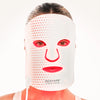
If I do not have candlelight or a warm amber incandescent lamp, I will often turn on a NuShape Therapy Wrap or Lipo Wrap and let the visible red LEDs light the room instead of switching on the overheads. You are not using the wrap as a substitute light bulb forever; you are simply creating enough warm red light to move around without flooding the room with a bright blue-heavy source.
See NuShape red-light wraps →Why Coffee Makes You Feel Less Tired — Without Removing the Tiredness
The longer you stay awake, the stronger your natural drive to sleep becomes. Researchers call this sleep pressure. One of the chemicals involved is adenosine. It gradually builds in the brain while you are awake and falls again during sleep.
Coffee does not remove that sleep pressure. Caffeine temporarily blocks the receptors that adenosine normally uses to make you feel tired. The tiredness signal is still building; you just cannot feel it as strongly for a while. That is why caffeine can make you feel alert without actually replacing the sleep your body needs.
Blocks the tiredness signal
Caffeine sits where adenosine would have sat. You feel more alert because the signal telling you to stop is no longer getting through.
Remove the need for sleep
No sleep pressure is removed or paid off. Everything that accumulated while the receptors were occupied is still waiting when the caffeine wears off.
The clearest caffeine rule concerns the end of the day. Caffeine often has a half-life around five hours, although people vary widely. In a controlled trial, 400 mg taken six hours before bed still reduced total sleep by more than an hour. That is why an afternoon coffee can matter long after you have stopped feeling stimulated by it.
The popular advice to wait ninety minutes after waking before drinking coffee is much less established. There is no good trial showing that ninety minutes is a magic number. Morning cortisol is already high, and some people simply prefer how they feel when coffee comes after light, water and movement. The usual explanation that early coffee causes adenosine to “pile up” and create an afternoon crash is not a good description of the biology. If delaying coffee feels better, keep it. The afternoon cut-off has much stronger evidence behind it.
What to Do, In Order
Two steps do most of the work: getting outside in the first hour, and making the evening darker. Everything else is refinement.
The order matters more than the timing. Kettle on, shoes on, out. Standing on a doorstep with a cup of tea counts, and it is far easier to keep up than a scheduled walk.
Free · Before the phoneThis is a practical rule, not a precision dose. Let ordinary daylight reach your eyes; do not stare at the sun. I usually walk because it gives me movement at the same time, but standing outside with a coffee still counts.
Free · 10–20 min · No sunglassesWater first, coffee once you have been outside. If your mornings will not stretch to it, this is the step to drop.
Free · Optional · Try it for a weekI use eight hours before bed as an easy rule. The six-hour study used a large 400 mg dose and still found more than an hour of lost sleep; eight hours simply gives more margin for individual differences in caffeine metabolism.
Free · Afternoon · The step people skipOne warm lamp, low in the room, instead of the overhead lights. It is a single switch made once, and it is the highest-return change available in the evening.
Free · Evening · One switch, made onceCover or unplug standby lights, close the gap in the curtains, and use a mask if the room will not go properly dark. The test is whether you can see your own hand.
Free · Nightly · A mask does it tonightYou do not need to turn all six steps into a project. Steps one and two are the core: get outside early and let your eyes register real daylight. Then make the evening noticeably darker. Coffee timing is useful, but it is not the point of the module.
Your body clock is waiting for two very old signals: bright days and dark nights. Give it both consistently and an enormous amount of biology starts falling back into rhythm.